What Are Stablecoins? A Plain-English Guide for 2026
Back to articles
TL;DR
- Stablecoins are cryptocurrencies pegged to a stable asset (usually the U.S. dollar), giving you fast transfers and low fees without the volatility
- Five types exist: fiat-backed, crypto-backed, commodity-backed, algorithmic, and flatcoins
- USDT and USDC dominate the market, together accounting for over 95% of stablecoin trading volume
- Primary use cases: cross-border payments, trading, DeFi yields, and inflation hedging in unstable economies
- Common buy paths: major exchanges, on-ramp apps, or directly via BurnerOS for USD II
If you've looked into cryptocurrency, you've probably wondered why anyone would want a "stable" crypto. Isn't the point of crypto that it might 10x or even 100x?
The answer becomes clear once you try to use crypto as money. Volatility makes it impractical for everyday payments, savings, or pricing anything. Stablecoins solve the problem by giving you a digital dollar that lives on a blockchain.
What Is a Stablecoin?
A stablecoin is a cryptocurrency built to hold a steady price, typically $1. While Bitcoin and Ethereum can swing 5-10% in a single day, a well-designed stablecoin stays within a fraction of a cent of its target.
Think of it like a digital dollar that moves as easily as email. You get crypto's benefits, fast transfers, low fees, 24/7 availability, programmability, without the volatility.
Why does this matter? Because moving $10,000 across borders with a stablecoin costs under $1 and settles in minutes. The same transfer through a bank costs $25-50 and takes 1-3 business days. For the 800 million people who receive remittances globally, that difference adds up.
The Top 5 Stablecoins by Market Cap
Not all stablecoins are equally trusted or liquid. While this article focuses on the dominant US dollar-pegged stablecoins, smaller markets exist for stablecoins pegged to euros, Brazilian real, and other currencies serving specific regions.
Here are the dominant stablecoin players as of early 2026:
| Rank | Stablecoin | Market Cap | Issuer |
|---|---|---|---|
| 1 | Tether (USDT) | $189.5B | Tether Ltd |
| 2 | USD Coin (USDC) | $77.2B | Circle |
| 3 | USDS | $11.1B | Sky (formerly Maker) |
| 4 | USD1 | $4.5B | World Liberty Financial |
| 5 | DAI | $4.4B | MakerDAO |
USDT and USDC together account for over 95% of stablecoin trading volume, and they're available on every major exchange and supported by most DeFi protocols:
USDT (Tether) has been the dominant stablecoin by volume since 2014, issued by Tether Limited. Its early years were marked by questions over reserve composition, culminating in a $41 million CFTC settlement in 2021 over past misrepresentations. Tether has since published quarterly transparency reports showing reserves heavily weighted toward U.S. Treasury bills, though it hasn't completed a full audit by a Big Four firm.
USDC (Circle) is issued by Circle and was originally co-launched with Coinbase, which remains a primary distribution channel. Circle publishes monthly attestations from Grant Thornton, with reserves primarily in short-term U.S. Treasuries and cash held at regulated institutions. The combination of regulatory posture and Coinbase backing has positioned USDC as the preferred option for U.S. businesses and institutions.
How Stablecoins Maintain Their Peg
The most common stablecoin model is fiat-backed, where each token in circulation is matched 1:1 by reserves of cash and short-term U.S. Treasuries. The mechanism is straightforward: if a stablecoin is supposed to be worth $1, and the issuer holds $1 in reserves for every token, anyone can exchange one for the other.
When a stablecoin trades below $1 on an exchange, traders buy it cheap and redeem it with the issuer for the full dollar. When it trades above $1, the issuer mints new tokens at $1 and sells them. This arbitrage loop pulls the price back to the peg.
The mechanism works because users trust the issuer actually has the reserves and will honor redemptions. If that trust breaks, as happened with TerraUSD in 2022, the peg breaks too. Not every stablecoin works this way: crypto-backed, commodity-backed, algorithmic, and flatcoin designs each maintain their pegs through different mechanisms.
The Five Types of Stablecoins
Not all stablecoins work the same way. Understanding the differences helps you pick the right one.
| Type | Backing | Examples | Risk |
|---|---|---|---|
| Fiat-backed | Cash & Treasury bills held by issuer | USDC, USDT, PYUSD, USD II | Lower |
| Crypto-backed | Overcollateralized crypto in smart contracts | DAI, LUSD | Medium |
| Commodity-backed | Physical assets like gold | PAXG, XAUT | Medium |
| Algorithmic | Software logic adjusting supply | FRAX (hybrid) | Higher |
| Flatcoin | Inflation or cost-of-living index | RAI, Nuon, Spot | Higher |
Fiat-backed stablecoins are the simplest. For every USDC or USDT in circulation, the issuer (Circle or Tether Ltd) holds a matching amount in cash and short-term Treasury bills. Monthly attestations from accounting firms verify the reserves.
USD II is a fiat-backed stablecoin created by Burner and issued on Base, Coinbase's layer 2 network. It's backed 1:1 by U.S. dollars and treasury reserves, held by Burner's financial partner Bridge and securely stored in a Privy-managed account. Transfers and swaps cost no gas inside BurnerOS.
Crypto-backed stablecoins use other cryptocurrencies as collateral. DAI, for example, is backed by Ethereum and other crypto locked in smart contracts. Because crypto is volatile, these stablecoins are overcollateralized. You might lock $150 of ETH to mint $100 of DAI.
Commodity-backed stablecoins represent physical assets. Pax Gold (PAXG) is backed by one troy ounce of gold stored in London vaults. It's pegged to gold's price, not $1.
Algorithmic stablecoins attempt to maintain their peg through code rather than reserves. TerraUSD's collapse in 2022 wiped out $40 billion when its algorithm failed under market stress. Most surviving algorithmic stablecoins now use hybrid approaches with partial collateral.
Flatcoins peg value to an inflation index or cost-of-living measure rather than a single fiat currency. Examples include RAI (Reflexer), Nuon, and Spot. The goal is to protect long-term purchasing power as the dollar's real value erodes, though the category is small and the designs are still being tested in practice.
For a deeper look at each category and individual stablecoins, see Top Stablecoins of 2026: An Investor's Guide.
What Can You Do With Stablecoins?
Stablecoins have moved well beyond crypto trading, and the activity is genuinely global. As a16z recently mapped using McKinsey and Artemis Analytics data, Asia drives nearly two-thirds of real-economy stablecoin payment volume, with North America and Europe accounting for most of the rest:
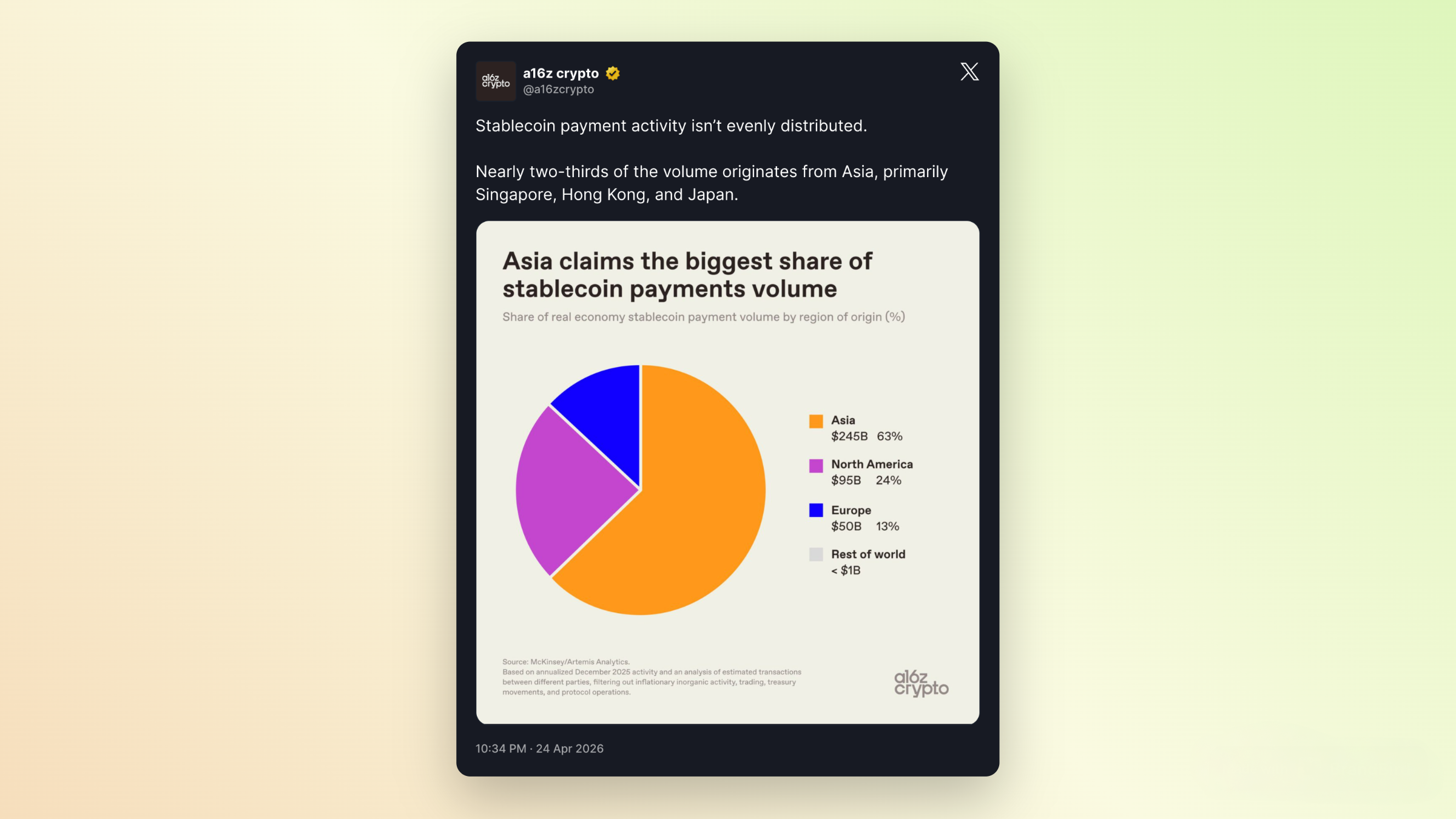
Caption: Stablecoin payment volume by region of origin. Source: @a16zcrypto on X, data from McKinsey/Artemis Analytics
That global distribution shows up across a few specific use cases:
Cross-border payments. Sending $500 from the US to the Philippines costs roughly $25 through traditional services and takes days. A stablecoin transfer costs under $1 and settles in minutes.
Trading and DeFi. Traders use stablecoins to park funds between positions without converting to fiat. They're also the primary currency in decentralized finance. Lending protocols, liquidity pools, and yield farming all run on stablecoins.
Savings in unstable economies. In Argentina, where annual inflation hit 211% in 2023, holding dollars is complicated by capital controls. Holding USDC provides similar protection without needing a foreign bank account. A Cornell study found that in countries with high inflation, stablecoin adoption is driven by necessity, not speculation.
Business payments. Companies increasingly use stablecoins for invoicing and payroll, especially across borders. Visa launched USDC settlement on Solana in late 2025, enabling partner banks to settle transactions seven days a week, and most recently expanded the pilot to nine blockchains, adding Base, Polygon, Circle's Arc, Canton Network, and Tempo (April 2026).
The same fee gap shows up at the merchant level. See Why Stablecoins Beat Card Payments for a per-transaction breakdown.
Are Stablecoins Safe?
Stablecoins are called "stable" because their price doesn't swing, but that doesn't mean they're risk-free. The risks look different from volatile crypto: they hinge on whether the peg holds, whether the issuer is trustworthy, and what code or reserves sit underneath. The main vulnerabilities to know about:
Depegging. Even well-backed stablecoins can briefly trade below $1 during banking stress. USDC dropped to $0.87 during the Silicon Valley Bank failure in March 2023 and recovered within days once the FDIC backstopped deposits.
Reserve transparency. You're trusting the issuer actually holds what they claim. Audit cadence and disclosure quality vary widely. For crypto-backed stablecoins like DAI, collateral is visible on-chain at all times.
Regulatory risk. Stablecoin rules are still evolving across jurisdictions. The US GENIUS Act and Europe's MiCA brought clarity for major issuers but could force design changes for smaller projects, and policy elsewhere remains unsettled.
Smart contract risk. Stablecoins built on smart contracts (crypto-backed, algorithmic, flatcoins) are exposed to bugs or exploits in the underlying code. The risk is highest for smaller, less-audited protocols.
Freezing risk. Fiat-backed stablecoins can be frozen by issuers. Circle has frozen accounts associated with sanctioned entities. For most users this isn't a concern.
In practice, the largest fiat-backed stablecoins, USDC and USDT, carry the lowest risk for everyday users, and well-regulated newer entrants like PYUSD and USD II follow the same fully-reserved model. They've held their pegs through multiple market crises, and the GENIUS Act and MiCA now give them a clear regulatory framework in the US and EU. Smaller or experimental designs carry more risk and are best left to users who understand the underlying mechanism.
How to Buy Stablecoins
Once you have stablecoins, you can hold them on the exchange (convenient but you don't control the keys) or transfer them to a self-custodial wallet you control. Software wallets like MetaMask, Phantom, or Trust Wallet are less secure than hardware wallets like Burner, which keep keys on a dedicated device.
Final Thoughts
Stablecoins fill a gap that regular crypto can't. They hold value while moving on the same rails as bitcoin and ether, with no price swings between sender and receiver. They're not exciting as investments (that's the point), but they're becoming infrastructure for how money moves globally.
For most people, USDC and USDT on a major exchange are the simplest entry points. USDC is generally favored for transparency, USDT for trading liquidity. Either gives you a stable on-ramp to the rest of crypto.
Disclaimer: This article is educational and not financial, investment, tax, or legal advice. Mentions of specific stablecoins, exchanges, or platforms are not endorsements. Do your own research before transacting with any stablecoin.
Frequently Asked Questions
❓ What are the 5 biggest stablecoins?
The top stablecoins by market cap are USDT (Tether), USDC (Circle), USDS (Sky), USD1 (World Liberty Financial), and DAI (MakerDAO). USDT and USDC alone make up over 95% of stablecoin trading volume. Rankings shift over time, so check CoinGecko for current numbers.
❓ Are stablecoins risky?
As with anything built on cryptocurrency, there's risk involved. The difference is that stablecoin risk looks nothing like the price volatility of assets like Bitcoin. The main vulnerabilities are depegging (if confidence in reserves breaks), regulatory changes, and issuer actions like account freezing. Well-backed stablecoins like USDC and USDT have maintained their pegs through multiple market crises, while algorithmic stablecoins have a poorer track record.
❓ How do USDC and USDT compare?
Both are pegged to $1 and trade within fractions of a cent of each other, but they're issued by different companies with different priorities. USDC (Circle) publishes monthly reserve attestations and is positioned for transparency and institutional use. USDT (Tether) has greater liquidity and broader trading-pair coverage but less consistent disclosures. Minor price differences come from supply, demand, and liquidity on specific exchanges; arbitrage keeps the gap small.
❓ What are USDC vs USDT gas fees?
Gas fees are the same for both stablecoins. They depend on the blockchain, not the stablecoin. Fees are typically higher on Ethereum's main chain than on faster chains like Solana or layer 2 networks like Base and Polygon, where transfers often cost fractions of a cent. Choose your chain based on speed and cost needs, not the stablecoin.
❓ How do I invest in stablecoins?
Stablecoins aren't investments in the traditional sense. They hold at $1 rather than appreciate. You can earn yield by lending them through DeFi protocols (5-10% APY typical) or centralized platforms. Common buy paths include major exchanges (Coinbase, Kraken, Binance), on-ramp apps like MoonPay, or BurnerOS for USD II.

Get your Burner
What to read next
Back to articles
Coldcard's $116M Hack: Why One Entropy Source Isn't Enough
Every security feature on a hardware wallet protects the key after it exists. The recent Coldcard hack, roughly $116 million drained from more than 5,200 addresses, shows what happens when the number behind that key came from one source and the source was wrong.

Who Is Satoshi Nakamoto? The Suspects and the 2026 Hunt to Unmask Bitcoin's Creator
More than 17 years after Bitcoin's first block, no one has proven who Satoshi Nakamoto is. We go through the leading suspects, the competing answers from a 2026 documentary and the New York Times, and what Satoshi's untouched coins say about holding bitcoin yourself.
What is a Real-World Asset (RWA)? A Guide to RWAs on Base and How to Securely Store Them
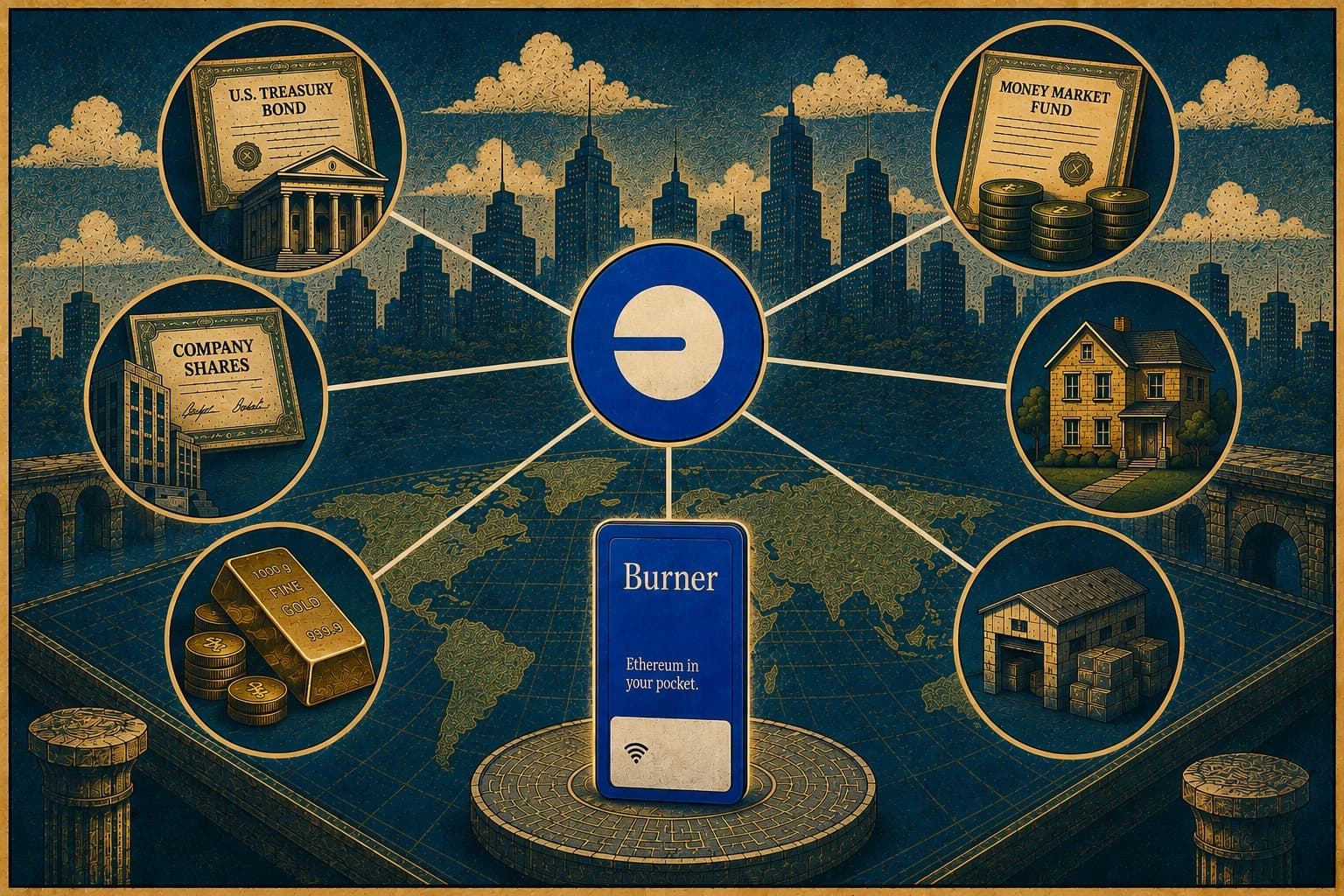
A real-world asset is something that exists off the blockchain, like a US Treasury bond, a money market fund, a bar of gold, or a share of stock, represented on-chain as a token. The token isn’t a new asset with value of its own. It’s a claim on the real one, recorded on a blockchain so it can be moved, split, and held the way you’d hold any cryptocurrency.