The Hidden Cost of Credit Card Payments for Small Businesses
Back to articles
TL;DR
Credit card fees quietly cost small businesses more than most owners realize.
- Card processing fees typically land around 2.5–3.5% and scale with revenue, not your actual costs.
- High-risk card processing can be much higher, sometimes approaching 10%, and often includes a $0.20–$0.30 flat fee on top of variable rates.
- Every card payment passes through banks, card networks, and processors, each taking a cut.
- Because fees come out of profit, not revenue, low-margin businesses feel the impact sooner.
- Merchants have limited options: absorb the fee, pass it on, or accept shrinking margins.
- For the first time in years, stablecoins offer a genuinely different payment rail with lower fees and more flexibility.
If you run a small business in 2026, accepting credit cards probably feels non optional. Fewer customers carry cash. People expect tap to pay. And every “Do you take cards?” is really asking whether you want the sale. The problem is the cost that shows up after the sale.
Credit card processing fees often land between 2.5% to 3.5% for small businesses. On a $100 sale, that can mean giving up a few dollars immediately. At a small scale it's easy to shrug off. At volume it becomes one of the biggest invisible expenses on your P&L.
This is the first post in a multi-part series on rethinking payments for small businesses, starting with why card payments are so expensive for merchants, how stablecoins have emerged as a credible and more flexible payment option, and how Burner Terminal, the first point of sale built for native tap-to-pay stablecoin payments, is designed to bring crypto to the counter.
Let’s begin by looking at what is inside processing fees, why small businesses rarely get to negotiate, and why the system is hard to escape.
How Card Payments Really Work
When a customer taps a card, the money does not move directly from their account to yours. It passes through a chain of intermediaries, and each one takes a cut.
A typical card transaction includes several layers of fees:
- Card network fees paid to Visa or Mastercard for routing, authorization, and settlement.
- Interchange fees paid to the issuing bank, the customer’s bank. This is usually the largest component and varies based on card type, rewards level, and how the transaction is taken.
- Processor markup and service fees added by your processor or acquiring bank. These can show up as a percentage, a per-transaction fee, monthly fees, gateway costs, or a combination of all three.
- Additional software and services such as POS software, fraud tooling, chargeback management, reporting, and other add-ons layered on top.
All of this is bundled into what appears on your statement as processing fees or an effective blended rate. In practice, the real cost often ends up higher than expected, especially for keyed-in payments, online transactions, and rewards cards.
For some businesses, especially those categorized as higher risk, processing costs can be significantly higher. High-risk merchants may see rates approach 8–10%, and many are charged a flat per-transaction fee of $0.20–$0.30 on top of percentage-based pricing. This often affects small businesses that sell online, take advance payments, operate in regulated categories like cannabis or CBD, or see higher-than-average chargebacks.
The point isn't the exact breakdown. You're paying into a system.

Why Card Fees Feel Worse Than They Look
Card fees don't scale with your costs. They scale with your revenue.
If your rent goes up, you can renegotiate a lease or move. If your supplier raises prices, you can switch suppliers. If a card network fee goes up, you usually don't get a say. Every time you increase prices to keep up with inflation, your processing fees rise with it.
Most business costs are fixed or semi-fixed, including:
- Labor
- Rent
- Inventory
- Utilities
Processing fees rise automatically with every price increase and every additional sale. That makes card fees feel less like a vendor expense and more like a percentage based tax on your business.
There are limited ways merchants can absorb processing fees:
- Absorb the fee directly. Over a year, this can add up to thousands of dollars depending on volume.
- Pass the fee on to customers. Some businesses add a surcharge or offer a cash discount, but customers notice, and it can add friction at checkout.
- Split the difference. Prices creep up, surcharges appear selectively. This spreads the pain but still means money leaves your business on every sale.
No matter which option you choose, a portion of your revenue is routed away from your business and into card networks, banks, and processors. Card fees affect merchants differently not because of industry or category, but because of margin.
If your net margin is 10% and your card fees average 3%, then roughly 30% of your profit disappears on every card transaction. Fees that sound small on paper feel large in practice because they are taken after you have already paid for labor, inventory, and rent. What remains is your profit.
This is why businesses with frequent, smaller transactions feel it sooner, even at modest scale.
The POS Status Quo
Once you understand how card payments flow, the next question is obvious: why does the system work this way?
The short answer is incentives. Card networks control the rails. Issuing banks earn interchange on every transaction. Processors and software providers build businesses on top of that foundation. The incentives across the system all favor maintaining the status quo.
Merchants are not the customers of this system. They are the throughput.
The incentives are built around keeping card volume flowing, not around lowering costs for businesses. Because customers expect to pay with cards, opting out is rarely realistic. That leaves merchants renting access to a private payment network on pricing terms they do not control and cannot meaningfully change.
There are periodic efforts to add competition or transparency, but the day-to-day merchant experience has barely changed. If you want modern digital payments, this is the system you're handed.
So What’s the Alternative?
For the first time in a long time, there's a real alternative.
Stablecoins are dollar-pegged digital currencies like USDC or USDT. They move over open blockchain networks instead of card networks. Fees can be meaningfully lower, and the cost structure is different. This doesn't mean you replace your current setup overnight. It means you can finally consider a payment method built on different incentives.
Stablecoins change the math on payments, but on their own they aren't a point-of-sale system. To work in the real world, they need to feel as simple and familiar as tapping a card. That's what Burner Terminal is for.
A new point of sale for stablecoin payments.

Final Thoughts
Card payments are convenient, but the fee structure was never built to favor small businesses. Processing fees often land between 2.5% and 3.5%, and they scale with your revenue, not your costs. For low-margin businesses, that can quietly consume a significant share of profit.
The good news is that the payments world is starting to get a second option. Stablecoins change the math, often reducing costs and removing many of the tradeoffs merchants have come to accept with cards.
FAQ: Credit Card Fees for Small Businesses
❓ What's the average credit card processing fee for a small business?
Many small businesses pay roughly 2.5% to 3.5% all in. The exact rate depends on card type, transaction method, and how the processor prices its services.
❓ Why do keyed in or online transactions cost more?
They typically fall into higher risk categories for fraud and chargebacks, which places them into different interchange tiers and results in higher effective fees.
❓ Can small businesses negotiate swipe fees with Visa or Mastercard?
Usually no. Most merchants work through processors and acquiring banks, and the underlying interchange and network fee structures are set centrally. Small businesses can sometimes change processor markup, but not the base rails.
❓ Is a cash discount the same as a credit card surcharge?
They may look similar to customers, but the rules, disclosures, and compliance requirements can differ by jurisdiction and processor. Businesses considering either approach should confirm local regulations and processor policies.
❓ Why do processing fees feel worse during inflation?
Because most fees are percentage based. When prices rise, the absolute fee rises with them, even though other costs like rent, labor, and inventory may already be under pressure.
❓ What alternatives exist to paying 2% to 3% on every card sale?
Some merchants use ACH for certain payments. A newer option is stablecoin payments, which operate on different economic models than card networks and can reduce fees while giving merchants more control over how and when funds settle.
❓ Do stablecoin payments replace cards entirely?
No. For most businesses, stablecoins work best as an additional payment option, not a full replacement.

Get your Burner
What to read next
Back to articles
Coldcard's $116M Hack: Why One Entropy Source Isn't Enough
Every security feature on a hardware wallet protects the key after it exists. The recent Coldcard hack, roughly $116 million drained from more than 5,200 addresses, shows what happens when the number behind that key came from one source and the source was wrong.

Who Is Satoshi Nakamoto? The Suspects and the 2026 Hunt to Unmask Bitcoin's Creator
More than 17 years after Bitcoin's first block, no one has proven who Satoshi Nakamoto is. We go through the leading suspects, the competing answers from a 2026 documentary and the New York Times, and what Satoshi's untouched coins say about holding bitcoin yourself.
What is a Real-World Asset (RWA)? A Guide to RWAs on Base and How to Securely Store Them
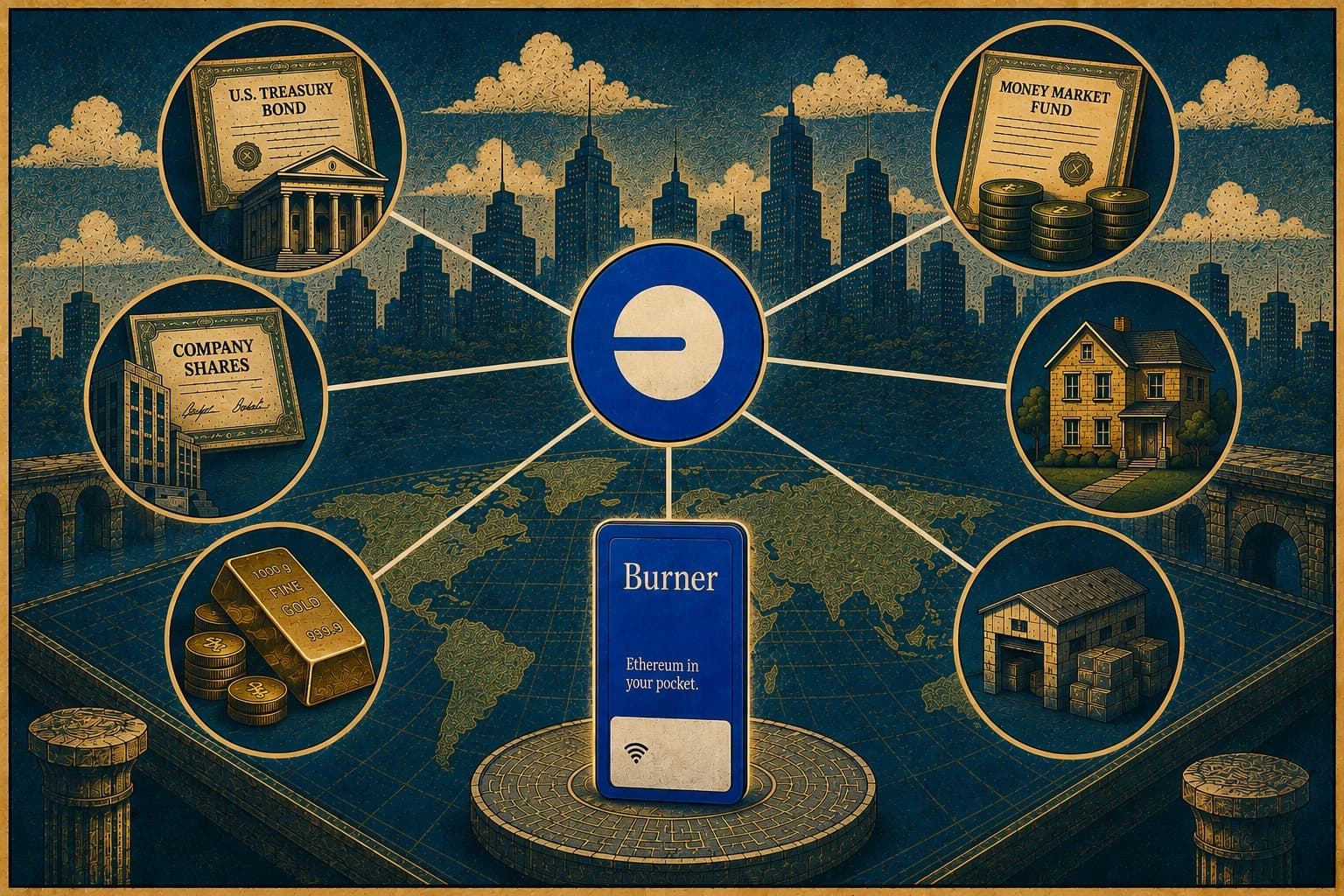
A real-world asset is something that exists off the blockchain, like a US Treasury bond, a money market fund, a bar of gold, or a share of stock, represented on-chain as a token. The token isn’t a new asset with value of its own. It’s a claim on the real one, recorded on a blockchain so it can be moved, split, and held the way you’d hold any cryptocurrency.