Payment Psychology That Makes Customers Spend More, And How You Can Copy It
Back to articles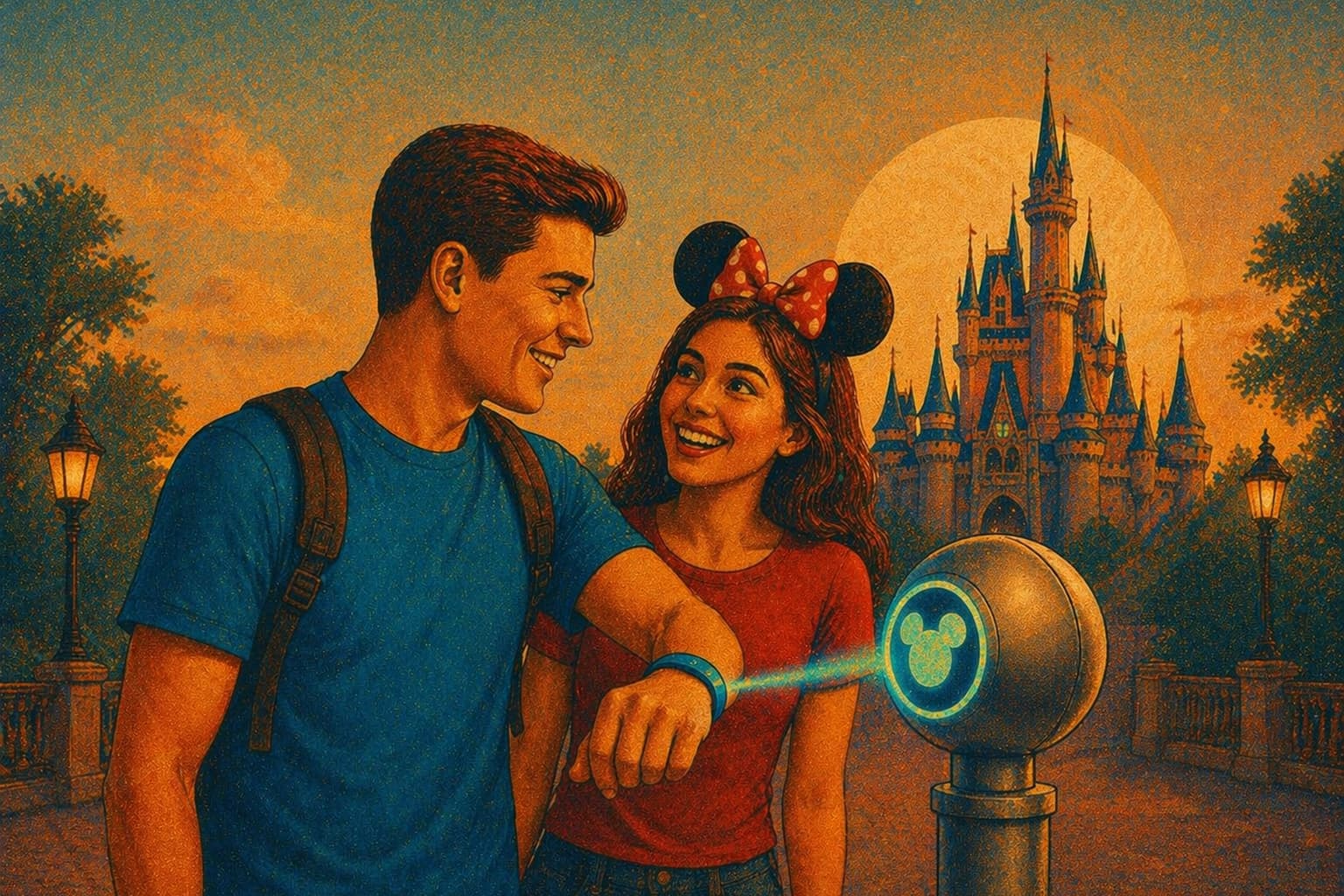
TL;DR
- Research shows customers spend 64-177% more when payment is abstracted away from the purchase
- Disney, Starbucks, casinos, and cruise lines all use the same trick: separate the moment of paying from the moment of buying
- Cash is the most psychologically painful way to pay, which means cash businesses face the steepest spending friction
- Stored-value systems (like loaded cards) reduce that friction because the money feels "already spent" at the time of purchase
- A Burner card loaded with stablecoins gives any small business access to stored-value psychology without building a proprietary system
A family at Walt Disney World doesn't pull out a credit card 30 times a day. They tap a MagicBand for the churro at the cart, the stuffed animal at the gift shop, and lunch at the quick-service counter, all without opening a wallet, collecting a receipt, or doing mental math between purchases.
In the quarter after MagicBands launched, per-capita guest spending at Disney World rose 8%, driven largely by higher food and merchandise purchases. The only thing that changed was how easy it was to pay.
The psychology behind this is well-documented, and the biggest consumer businesses in the world have been using it for decades. But small businesses, especially cash-heavy ones, have been locked out of it until recently.
The Psychology of Paying
In 2001, Drazen Prelec and Duncan Simester at MIT ran an experiment that became one of the most cited studies in behavioral economics. They auctioned off tickets to sold-out sporting events and told half the bidders they'd pay with cash, the other half with credit card. The credit card group bid 64-177% higher for the same tickets.
The participants, events, and seats were identical; the only variable was how they'd pay. Credit cards won because they're abstract: you don't watch money leave your hands, the bill arrives later lumped in with everything else, and the connection between "I'm buying this" and "I'm losing money" gets weaker.
Researchers call this the "pain of paying," and it's measurable across a clear spectrum of payment methods.
Cash sits at the top of the pain scale. Handing over physical bills is the most direct way to feel a purchase, which is exactly why people spend less when they do. Priya Raghubir and Joydeep Srivastava's 2008 study on payment form found that the more physical the payment method, the stronger the awareness of what's being spent.
Credit cards reduce the pain significantly. By the time the bill shows up, it's bundled into the month's total and the link between buying and paying has faded. Dilip Soman's 2001 research found that credit card users have weaker "rehearsal" of their spending, meaning they literally remember less about how much they've paid.
Stored value is the lowest-pain option. When you load money onto a card, a wristband, or an app balance, the payment happens at the loading moment. Every purchase after that feels like it's already been paid for. Psychologically, you're spending "house money." Richard Thaler and Eric Johnson described this house money effect in 1990: people take more risk and spend more freely with money they've mentally categorized as already gone.
The difference between those two ends of the scale isn't small. Across the consumer economy, it adds up to billions of dollars in spending that either happens or doesn't.
Who Already Figured This Out
The businesses that understood this earliest built entire payment ecosystems around it.
Casino chips are the original payment abstraction. Casinos figured out decades ago that people bet more freely with colored discs than with cash. Once a bill has been swapped for a stack of chips, it stops registering as money. Players track their bets in chips rather than dollars, and the distance from real currency makes wagers feel smaller than they are. The psychology is so effective that casinos have resisted digital alternatives partly because the physical abstraction already works so well.
Starbucks turned a coffee shop into a bank. The Starbucks app holds $1.6 billion or more in stored-value balances at any given time, more than many regional banks hold in deposits. Starbucks Rewards members account for roughly 57% of U.S. revenue and spend an estimated two to three times more than non-members. For Rewards members, paying happens at the moment they reload the app, not at the counter. By the time the latte is in hand, the cost has already faded into the background, which is one of the reasons Rewards customers spend so much more per visit than walk-ins.
Cruise lines perfected the closed-loop system. Passengers get an onboard card tied to their cabin. No cash changes hands for the rest of the trip. The result: cruise passengers typically spend $70-$90+ per person per day in onboard spending on excursions, drinks, spa treatments, and specialty dining. The card removes every moment of friction between wanting something and buying it.
The pattern across all of these is the same: separate the payment from the purchase, make the buying moment feel frictionless, and a better experience and higher spending reinforce each other.
Related: For more on how payment rails affect merchant margins, read The Hidden Cost of Credit Card Payments for Small Businesses
Why Cash Businesses Have the Opposite Problem
If stored value sits at the bottom of the pain scale, cash sits at the very top. And cash-heavy businesses pay for that in ways they can't always see.
Every purchase requires a physical handoff. The customer counts out bills, waits for change, puts the change away. Each transaction adds 15-30 seconds of friction where the customer is actively thinking about the money leaving their hands.
Customers self-limit because they feel every dollar. A cash customer at a food truck might want the extra side or the larger size, but they're looking at the bills in their hand and doing subtraction in real time, and that running calculation is what holds the impulse back.
Running out of cash means the spending stops. A customer with a credit card will keep browsing, but a customer with an empty wallet is done, even if they want to keep going. And an ATM trip is its own cooling-off period, with the impulse usually faded by the time they return.
At high volume, slow lines cap the day's revenue. At food trucks, pop-up markets, and festival booths, every extra 10 seconds per cash transaction stretches the queue and pushes some customers to walk off without ordering.
None of this means cash is bad. Cash businesses have real advantages, including zero processing fees and no chargebacks. But cash carries the highest psychological friction of any payment method, and that friction has a real cost in revenue per customer.
The Stored-Value Opportunity for Small Businesses
When a customer loads $50 onto a stored-value card, the business has the cash before the first sale, and the customer mentally files the $50 as spent. Every purchase afterward feels like it's coming from money that was already gone, which is the house money effect at work: spending feels easier, decisions happen faster, and average ticket size drifts upward.
The cash flow alone beats credit cards, which settle in one to three business days, and considerably beats invoicing. Traditional gift cards bank on breakage, where 2-10% of loaded value goes unredeemed, as upfront revenue for products never delivered. Burner works differently: the balance stays in the customer's self-custodial wallet, so the merchant doesn't keep what isn't spent. The tradeoff is trust, since money that's never trapped or forfeited should make customers more comfortable loading in the first place, and a remaining balance still pulls them back: a $12 leftover is a reason to return.
Until recently, this required massive scale (Starbucks), a closed environment (cruise ships, theme parks), or a custom app. Small businesses had no practical way in.
A food truck averaging a $12 cash ticket that moves 40 transactions a day to stored value, at a conservative 20% spending lift (well below what the research predicts), nets roughly $96 in extra daily revenue without a single new customer.
How Burner Card and Terminal Fit In
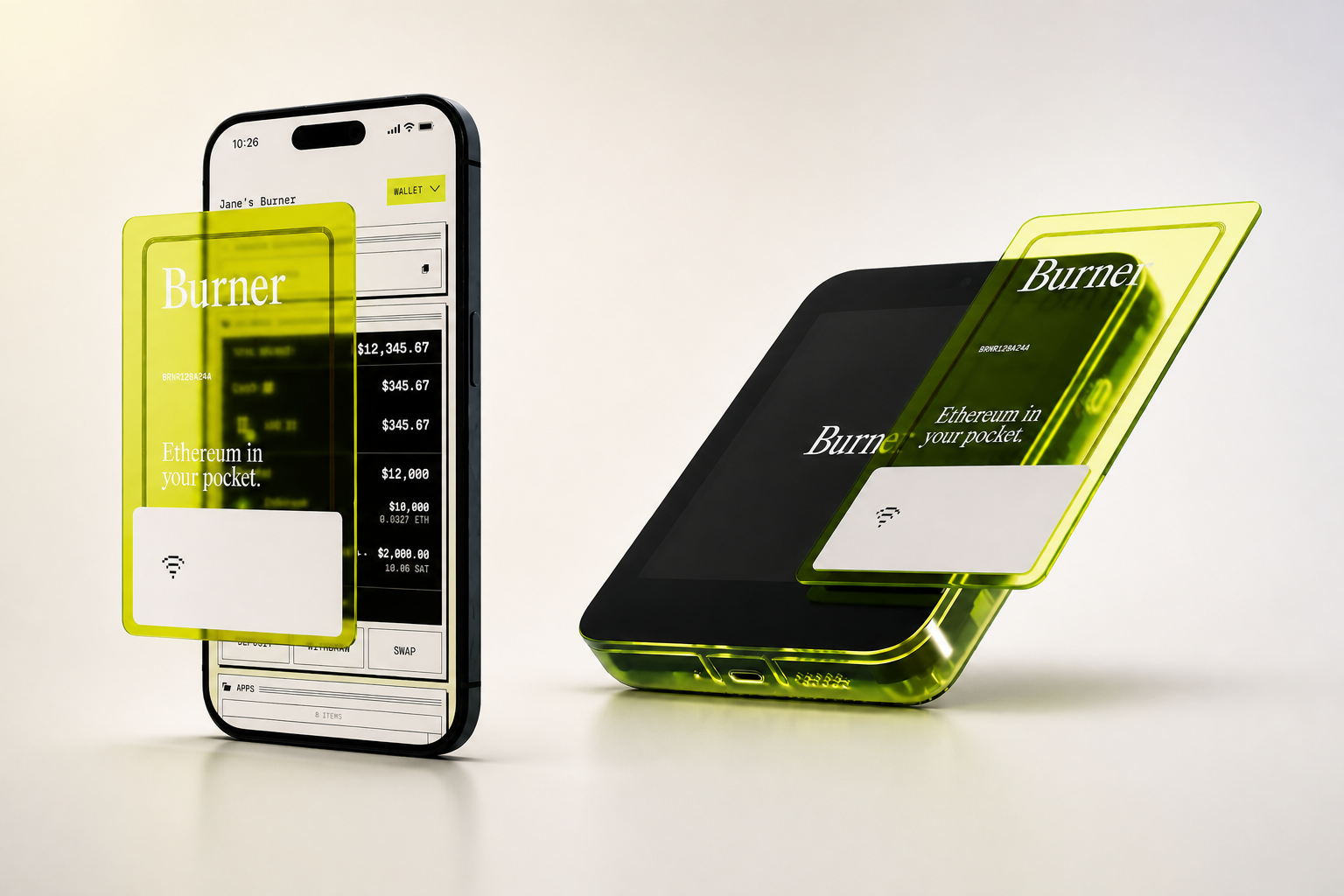
Burner card (left), Burner Terminal (right)
A Burner card loaded with stablecoins functions as a stored-value card. The customer loads digital dollars onto their card, walks up to a Burner Terminal, and taps to pay.
This gives a taco truck, a barbershop, a pop-up vendor, or a farmers market booth access to the same stored-value psychology that Disney spent over a billion dollars engineering into MagicBands. There's no proprietary app to build, no wristband infrastructure, no closed-loop campus required.
Burner Terminal is designed around speed: the customer taps their loaded Burner card, the payment confirms, and they move on. No signatures, no PINs entered on a terminal screen, no waiting for authorization from a card network.
The card itself is the customer's property, secured by their PIN with a non-extractable private key on a secure chip. It works as a self-custodial crypto wallet the customer can use to send, receive, and hold stablecoins.
For merchants already running cash-heavy operations, adding a digital payment option that doesn't cost 2.5-3.5% per transaction, and get the spending psychology of stored value built into how the payment works.
A new point of sale for stablecoin payments.

Final Thoughts
When payment doesn't interrupt the experience, people spend more and enjoy themselves more. Disney, Starbucks, and every casino in Las Vegas have been running on this principle for years. Cash businesses have been stuck on the wrong end of it: cash is the most psychologically painful payment method, but card processing at 2.5-3.5% eats the margins that made cash-only work.
Stablecoins on stored-value cards change that equation. A Burner card gives customers cash-like flexibility in digital form, tap-to-pay convenience through Terminal, and stored-value psychology without a proprietary platform. The billion-dollar insight no longer requires a billion-dollar infrastructure budget.
FAQ: Stored-Value Payments and Spending Psychology
❓ Does this mean I'm tricking my customers into spending more?
No. The research consistently shows that customers who spend more through stored-value systems also report higher satisfaction. The higher spending comes from removing payment friction that would otherwise interrupt the experience. Disney guests love MagicBands and Starbucks users love the app precisely because the experience is better, and the higher spending follows from that.
❓ How is a Burner card different from a gift card?
A gift card is a bearer instrument. Whoever holds it can spend it, and if you lose it, the value is typically gone. A Burner card is a hardware wallet secured by a PIN with a non-extractable private key on a secure chip. It works as a self-custodial crypto wallet the customer can use to send, receive, and hold stablecoins, and it spends at any merchant with a Burner Terminal. Unlike a gift card, it's their wallet, not store credit on a plastic card.
❓ What if a customer loads money and never comes back?
The biggest objection to any prepaid system is "what if I don't use it all?" With Burner, that worry mostly goes away. The balance lives in the customer's own wallet, so the money is never trapped or forfeited. You still get the cash the moment they load, and whatever's left over is a reason for them to come back. You don't pocket the unspent value the way a gift card would, but the bet is that customers who trust their money is safe will load more, load bigger, and return more often, and that more than makes up for the breakage you'd otherwise keep.
❓ Do I need to stop accepting cash to use this?
Not at all. Burner Terminal accepts cash, cards, and stablecoins. The stored-value option is an addition to your existing payment methods, not a replacement. Some customers will load a card. Others will keep paying cash. The point is giving customers a choice that happens to benefit both sides.
Get your Burner
What to read next
Back to articles
Coldcard's $116M Hack: Why One Entropy Source Isn't Enough
Every security feature on a hardware wallet protects the key after it exists. The recent Coldcard hack, roughly $116 million drained from more than 5,200 addresses, shows what happens when the number behind that key came from one source and the source was wrong.

Who Is Satoshi Nakamoto? The Suspects and the 2026 Hunt to Unmask Bitcoin's Creator
More than 17 years after Bitcoin's first block, no one has proven who Satoshi Nakamoto is. We go through the leading suspects, the competing answers from a 2026 documentary and the New York Times, and what Satoshi's untouched coins say about holding bitcoin yourself.
What is a Real-World Asset (RWA)? A Guide to RWAs on Base and How to Securely Store Them
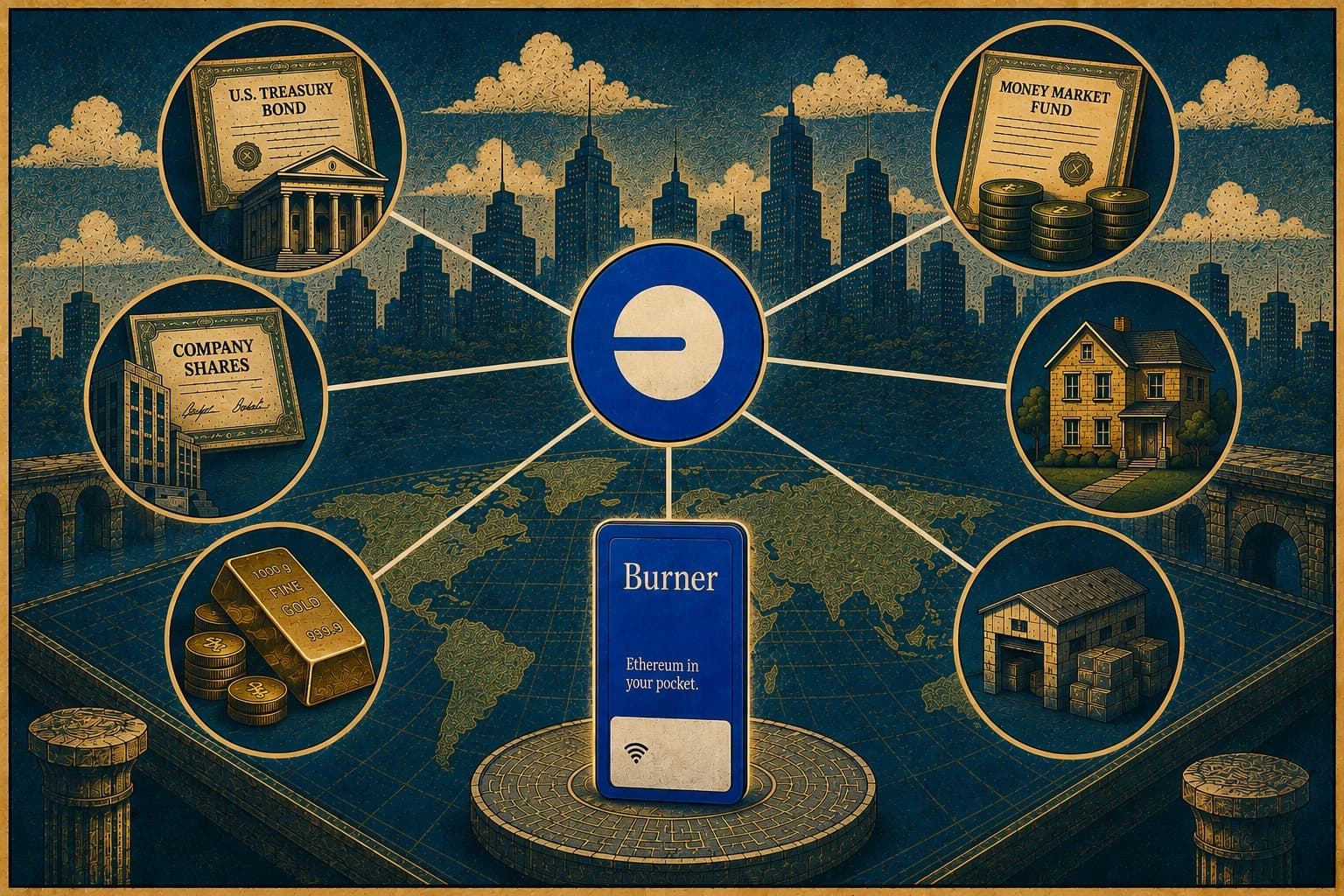
A real-world asset is something that exists off the blockchain, like a US Treasury bond, a money market fund, a bar of gold, or a share of stock, represented on-chain as a token. The token isn’t a new asset with value of its own. It’s a claim on the real one, recorded on a blockchain so it can be moved, split, and held the way you’d hold any cryptocurrency.